
Whitsunday Islands Travel Guide
The Whitsundays are a tropical island archipelago scattered all over the Great Barrier Reef just off the coast of Queensland. Towering forested peaks rise straight up from the Coral Sea and are edged by some of the quietest bays, the whitest beaches and the most beautiful coral reefs you’re ever likely to see.
Whitehaven Beach, Hill Inlet and Heart Reef are the ones everyone’s heard of and for good reason. But beyond those familiar spots, walking tracks wind their way into the heart of the national park, coral reefs pop up surprisingly close to shore, and you’ll find some pretty remote island campsites hidden behind beaches that can only be accessed by boat.
- Half day
- 7 hours

- $ 572 AUD
- $ 472 AUD
- 1 Day
- Returns: 4.30pm

- $ 238 AUD
- $ 138 AUD
- 1 Day
- Returns: 4.30pm

- $ 259 AUD
- $ 209 AUD
- 60-minute

- $ 533 AUD
- $ 335 AUD
- 60 min.
- $ 635 AUD
- $ 335 AUD
- 60 min.

- $ 635 AUD
- $ 335 AUD

Unspoilt Archipelago
There are 74 Whitsunday Islands to explore — they’re actually all part of the old Australian continent: the bit that got left behind as sea levels rose and we were cut off from mainland Australia. Their history is still visible in their shape and outline; unlike coral reefs, which tend to sit low on the horizon, many of the Whitsundays shoot sharply upwards from the sea, their forested island slopes running all the way down to the water.
A big chunk of the Whitsunday Islands National Park and the surrounding waters of the Great Barrier Reef Marine Park are right here — and on Whitsunday Island, the largest of the lot, you’ll find eucalypt woodland and rainforest turning into coastal vine forest, mangroves and even stands of hoop pine.
This is Ngaro Country — the Ngaro people have been connected to the islands and the surrounding waters for thousands of years, with archaeological sites proving just how long their history here is.
The name Whitsunday arrived a lot later, when Captain James Cook sailed past the passage between the islands and the mainland way back in June 1770 and named the passage for the day he believed it to be: Whit Sunday.

Natural Icons
The combination of clear blue-green water, brilliant sand and lush national park forest creates the landscape that has made this part of tropical Queensland so recognisable.
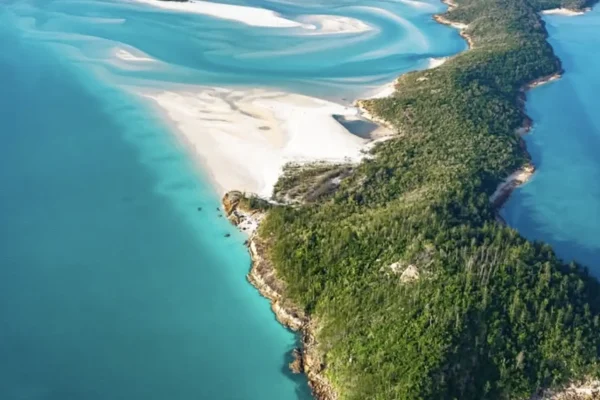
At the northern end, Hill Inlet is always on the move. The tide constantly changes the shallow water through the sandbanks, recasting the ocean’s famous blue-and-white tidal patterns throughout the day. If you hike up to Hill Inlet Lookout, the curves of the water spread out below you in all their glory; and from there, take a track down to Tongue Point, then on to the beaches and the inlet itself.
A bit farther out to sea, Heart Reef stands out as a small, unmistakable shape amongst the much larger Great Barrier Reef. From down on the water it can be tricky to recognise, but from the air, its distinctive heart-shaped coral formation becomes clear.
A scenic flight over Whitehaven Beach gives you the chance to fly over all three landscapes in one trip. The beach looks like a narrow white ribbon from the air, while Hill Inlet appears as sweeping tidal channels, and the coral formations further offshore look like a mosaic beneath the changing colours of the sea. From up high, the islands don’t look so isolated; it’s all just one massive, interconnected tropical seascape.

Reef & Marine Life
Coral actually grows much closer to land than most people think. Fringing coral reefs occur around several islands, creating snorkelling locations that can be reached from beaches or directly from a boat.
Snorkelling in shallow water keeps you close to areas where sunlight reaches coral near the surface. Scuba diving lets you explore deeper structures below the water. There’s plenty to see in these waters, too — sea turtles, rays and reef fish and other reef inhabitants are all moving through there, and green, hawksbill and flatback turtles occur within the wider region. What you see depends on the season, the conditions and just a bit of luck.
Things get a lot more interesting during the cooler months when humpback whales migrate through Queensland’s waters. They may pass through the Whitsundays on their way, and with forests, mangroves and headlands above the water, you’ll also find yourself in excellent coastal bird-watching territory.
You have to give wildlife some room when you’re out turtle watching; never touch or feed marine animals, and don’t follow them around. It’s just the same with living coral communities — take care not to stand on them and follow current Great Barrier Reef Marine Park guidance on responsible reef visits and sun protection.
The ocean can turn your day into a real rollercoaster in no time; the wind picks up and roughens the water, underwater visibility can change, and tides alter the depth over shallow reef. On top of that, Cid Harbour has specific shark-risk advice, so be sure to check the park’s latest alerts and sea conditions before entering the water.

Eco-Adventures
The Whitsunday Ngaro Sea Trail incorporates the sea into the path. Walking areas across Whitsunday, South Molle and Hook islands are linked by water, weaving bushwalking, paddling and island hopping into the same journey.
On Whitsunday Island, the 32-kilometre Ngaro Track opened for its inaugural hiking season in 2026. It runs between the Whitehaven Beach and Hill Inlet areas through the island’s interior, with boat access and advance bookings required. Other tracks climb higher, including routes towards Whitsunday Peak at 437 metres above sea level.
A kayak brings the coastline down to human scale. Secluded island coves become natural stopping points, rocky edges pass slowly beside the hull, and some walking tracks and campsites can be approached directly from the water. Short distances on a map can still mean exposed sea crossings, so tides, currents, wind and paddling ability matter. Travel insurance should be checked carefully when independent adventure activities such as kayaking, hiking or scuba diving need to be covered.
Staying overnight strips the experience back further. Queensland Parks lists 25 camping locations across the Whitsunday islands, some tucked behind beaches with little beyond forest and sea. Camping permits are required, facilities vary, and campers need to arrive self-sufficient with drinking water and take all rubbish with them.

How To Explore
Fast marine vessels cross the larger gaps efficiently. Catamarans can offer a steadier platform, while sailing through the archipelago suits the natural shape of the region — islands, channels and anchorages appearing one after another across the Coral Sea.
Spending longer aboard leaves room for quieter bays and reef sites away from the main landing points. Kayaks move at the opposite pace: close enough to shore to notice individual coves, mangrove-lined coastline and changes in the rock, but much more dependent on wind, tides and paddling ability.
On foot, the perspective shifts again. A beach disappears behind the trees; the track climbs, and suddenly the view opens across island ridgelines and reef and blue water. Longer walks reach parts of the islands that remain completely hidden from offshore.
The greatest change of scale comes from the air. Hill Inlet’s tidal channels spread across the sand like broad brushstrokes, Heart Reef takes on its familiar outline, and Whitehaven becomes a thin white line against the forest. Seen from above, the islands reveal their real geography: continental island fragments rising through a vast field of reef and Coral Sea.
FAQ
What makes the Whitsunday Islands so famous?
They’re primarily famous for Whitehaven Beach, Hill Inlet, Heart Reef and the Great Barrier Reef. The archipelago combines protected national park islands, coral reefs, crystal-clear tropical waters and diverse marine life in one spectacular region.
Is Whitehaven Beach part of the Whitsunday Islands?
Yes. Whitehaven Beach sits on Whitsunday Island — the biggest of the 74 — and runs for about seven kilometres. Famous for its white silica-rich sand, its northern end meets Hill Inlet, where a lookout overlooks the shifting patterns created by white sand and turquoise water.
Can you snorkel the Great Barrier Reef in the Whitsundays?
Yes. Whitsundays snorkelling sites include fringing reefs around several islands, including locations around Hook Island and elsewhere in the archipelago. Conditions change with wind, tides and water visibility, so the quality of a particular snorkelling site can vary from day to day.
What's the best time of year to visit the Whitsunday Islands?
You can visit throughout the year, but May to October is popular for generally cooler temperatures, lower humidity and typically drier conditions, making it an appealing period for sailing, hiking and snorkelling. Humpback whale migration also occurs through Queensland waters during the cooler part of the year.
What's the best way to see the Whitsunday Islands?
There are loads of ways to see them — sailing, catamaran, kayak, hiking or scenic flight. Sailing lets you explore channels and secluded bays between islands, hiking takes you into the forested island interiors, and a scenic flight provides an aerial perspective over the region’s best-known natural landmarks.


Experience The Best Of Brisbane
The river is the natural place to start. Ferries and bridges connect the two banks, while riverside walking paths lead between gardens, restaurants and city views.
South Bank Parklands sits directly opposite the Brisbane CBD, bringing together around 15 hectares of parkland, Streets Beach and the Queensland Cultural Centre. Across the river, Queen Street Mall and the 18-hectare City Botanic Gardens offer a mix of busy city streets and quieter waterfront spaces.
Kangaroo Point has some of the best views of the Brisbane skyline and Story Bridge. Nearby, Howard Smith Wharves brings dining and riverside spaces beneath the bridge. New Farm, Fortitude Valley and West End add another mix of parkland, nightlife, leafy streets and charming cafés.

See Brisbane Beyond The City Centre
West of the CBD, Mt Coot-tha Reserve is the place for bushwalking trails, outdoor adventures and panoramic city views, with the 56-hectare Brisbane Botanic Gardens Mt Coot-tha adding another reason to spend time on this side of the city.
Head east and Brisbane meets the bay. Wynnum and Manly have a quieter, more laid-back waterfront feel than the surf coast to the north and south. Further out, Minjerribah (North Stradbroke Island) and Mulgumpin (Moreton Island) bring beaches, walking trails, wildlife and wilder coastal scenery.
Travel inland instead and the Scenic Rim brings mountains, national parks and access to World Heritage-listed rainforests, putting very different landscapes within easy reach of the city.

Food, Art And Culture In Brisbane
South Bank is Brisbane’s main cultural hub. The Queensland Cultural Centre brings the Queensland Art Gallery, Gallery of Modern Art, Queensland Museum, State Library and Queensland Performing Arts Centre together in one convenient riverside cultural precinct. GOMA is also home to the Australian Cinémathèque, where film screenings sit alongside the galleries and exhibitions.
Food and nightlife are more spread out. South Bank works well for riverside dining, while Fortitude Valley mixes restaurants, bars and live music. New Farm has a more relaxed neighbourhood feel built around cafes, and West End is known for independent eateries and a broad mix of international cuisines. Whether the plan is a riverside meal, a night out or a laid-back Brisbane brunch, there are plenty of options.
Brisbane is compact enough to mix art, culture, food and markets into the same day of sightseeing. There is little reason to separate them into dedicated days when the city’s main inner-city precincts fit together so easily.

Make Time For Brisbane
2 to 4 days in Brisbane is a good amount of time for a first visit. Two days gives you enough time to explore the river, South Bank Parklands, the city centre and surrounding neighbourhoods. A third leaves room for Mt Coot-tha or the bayside, while four days makes it easier to add an island trip, the coast or hinterland.
Summer is the hottest and most humid time of year, autumn is milder, winter brings cooler days and evenings, and spring in Brisbane warms up as the jacarandas begin to flower.
You don’t really need a car around central Brisbane. Trains, buses and ferries cover much of the city, while South Bank, the city centre and nearby neighbourhoods are easy to explore on foot. A car becomes more useful for day trips from Brisbane to the coast, hills and surrounding regions.
Accommodation ranges from luxury riverside hotels and central city stays to boutique hotels and apartments in the inner suburbs. That leaves plenty of choice between nightlife, river views and a quieter base.