
Whitsunday Travel Guide
The Whitsundays bring together 74 Whitsunday Islands, the Coral Sea and the Great Barrier Reef in one of tropical Queensland’s most distinctive landscapes. Airlie Beach and Hamilton Island serve as the two main gateways, with Whitehaven Beach, Hill Inlet, and Heart Reef among the region’s defining natural sights.
- 1 Day
- Returns: 4.30pm

- $ 259 AUD
- $ 209 AUD
- 60 min.
- $ 635 AUD
- $ 335 AUD
- 60 min.

- $ 563 AUD
- $ 335 AUD
- 1 Day
- Returns: 4.30pm

- $ 238 AUD
- $ 138 AUD
- 60 min.

- $ 635 AUD
- $ 335 AUD
- 60-minute

- $ 533 AUD
- $ 335 AUD

Tropical Paradise: 74 Islands, Turquoise Water & Coral Reefs
The 74 Whitsunday Islands form part of the Great Barrier Reef World Heritage Area, a landscape of forested islands, sheltered passages, beaches and coral-filled marine waters.
Only a handful are extensively developed. Hamilton Island, Daydream Island and Hayman Island provide the best-known resort experiences; much of the archipelago remains a national park. Around the islands, the Great Barrier Reef Marine Park protects coral reefs inhabited by sea turtles and other marine life and serves as a seasonal migration route for humpback whales.
Long before resorts and sailing holidays arrived, the islands were home to the Ngaro people, Traditional Custodians of the Whitsunday region. Their connection with the islands and surrounding marine waters stretches back thousands of years, with archaeological sites preserving evidence of this long occupation.
Today, island hopping, sailing trips, snorkelling and diving follow the natural geography of an archipelago, where most places are still reached by sea.

Airlie Beach: The Mainland Hub
Airlie Beach is the practical mainland base for exploring the Whitsundays. From Coral Sea Marina and nearby departure points, boats head for Whitehaven Beach, Hill Inlet, Hamilton Island and the Great Barrier Reef, with options ranging from fast day trips to reef cruises, crewed charters and overnight boating.
On shore, restaurants, bars and accommodation cluster around the centre alongside the Airlie Beach Lagoon and the town’s established backpacker scene. Having so many services in one place makes it possible to stay put while taking different routes into the islands on successive days.
The mainland opens up in the opposite direction. Cedar Creek Falls lies inland, with Dingo Beach and Hydeaway Bay farther along the coast. Travellers arriving by air use Whitsunday Coast Airport, while road connections continue north and south along the Queensland coast.

Hamilton Island: Stay Among The Islands
Hamilton Island shifts the base offshore, placing beaches, accommodation, restaurants and a marina among the Whitsunday Islands themselves.
Its Hamilton Island Airport provides direct air access, and boats connect the island to Whitehaven Beach, Hill Inlet, and the Great Barrier Reef. Away from the developed areas, walking trails climb to views across neighbouring islands and the Coral Sea.
The marina becomes particularly busy during Hamilton Island Race Week, when yachts gather for one of Australia’s best-known sailing events. Elsewhere in the archipelago, Daydream Island offers another easily accessible resort option; Hayman Island, farther north, is more secluded.
Airlie Beach and Hamilton Island serve different geographical roles: one sits on the mainland beside the principal marinas and road network; the other places accommodation directly within the island group.

Whitehaven Beach & Hill Inlet
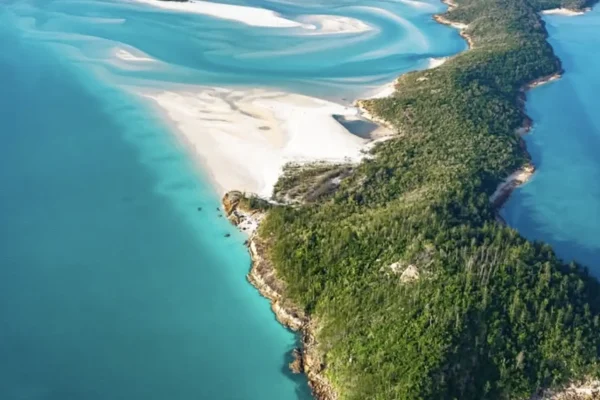
Whitehaven Beach stretches for around 7 kilometres along Whitsunday Island, its exceptionally pale, silica-rich sand bordered by turquoise water and forested hills.
At the northern end, tides move through Hill Inlet, continually rearranging shallow water and white sandbars into the swirling patterns associated with the Whitsundays. The classic elevated perspective comes from Hill Inlet Lookout, reached by a short walk through the forest.
Although Whitehaven Beach and Hill Inlet are often presented together, tour itineraries differ. Some visit the beach without including the northern inlet or lookout, so the exact landing point and walking access are worth checking before booking.
Deeper into Whitsunday Island, Whitsunday Peak rises above the surrounding forest. Reaching its higher viewpoints requires a substantially longer walk than the short Hill Inlet lookout route and offers views across a much wider section of the archipelago.

Scenic Flights & Cruises
A scenic flight over Whitehaven Beach changes the scale completely. From above, the long white shoreline, Hill Inlet and surrounding islands become part of the same landscape. Flights extending towards the Great Barrier Reef may also pass Heart Reef and larger coral formations that are difficult to distinguish from sea level.
Helicopter tours provide another aerial option, with routes and landing options varying by operator.
On the water, experiences range from leisurely sailing trips between islands and anchorages to faster boat trips combining Whitehaven Beach, Hill Inlet, and snorkelling in a single day. Liveaboard sailing, crewed charters and overnight boating extend the journey beyond a day excursion, replacing the evening return to the mainland with a night among the islands.
Farther towards the Great Barrier Reef, reef tours and reef cruises focus more heavily on the underwater environment. Snorkelling and scuba diving provide closer access to coral reefs and their inhabitants; sea turtles are found throughout these waters, and migrating humpback whales bring seasonal whale watching to the Whitsundays.
From a lookout, boat or aircraft, the same geography changes dramatically — from individual beaches and coral reefs at water level to the broader pattern of islands, channels and open Coral Sea from above.
FAQ
How many islands are in the Whitsundays?
The Whitsundays consist of 74 islands scattered through the Coral Sea off Queensland’s central coast. Most are undeveloped, while Hamilton Island, Daydream Island and Hayman Island are among the best-known resort islands.
How many days do you need in the Whitsundays?
Allow 3–5 days for a first trip. This gives enough time for a full-day island or reef excursion, Whitehaven Beach and Hill Inlet, and some flexibility for another sailing, snorkelling or scenic flight experience.
Is Airlie Beach or Hamilton Island better for the Whitsundays?
Airlie Beach is better suited to travellers who want mainland flexibility, a broad choice of tours, and road access. Hamilton Island suits those who prefer to stay within the archipelago and have beaches, resorts and boat connections close at hand.
Can you visit the Great Barrier Reef from the Whitsundays?
Yes. Reef tours and cruises from the Whitsundays travel towards the Great Barrier Reef, with some trips offering snorkelling and scuba diving. Fringing coral reefs can also be found around parts of the islands.
What is the best way to see the Whitsundays?
A boat trip provides the most complete introduction because it can combine islands, beaches and snorkelling. A scenic flight offers a different perspective on Whitehaven Beach, Hill Inlet, and sections of the Great Barrier Reef, including routes that may pass over Heart Reef.


Experience The Best Of Brisbane
The river is the natural place to start. Ferries and bridges connect the two banks, while riverside walking paths lead between gardens, restaurants and city views.
South Bank Parklands sits directly opposite the Brisbane CBD, bringing together around 15 hectares of parkland, Streets Beach and the Queensland Cultural Centre. Across the river, Queen Street Mall and the 18-hectare City Botanic Gardens offer a mix of busy city streets and quieter waterfront spaces.
Kangaroo Point has some of the best views of the Brisbane skyline and Story Bridge. Nearby, Howard Smith Wharves brings dining and riverside spaces beneath the bridge. New Farm, Fortitude Valley and West End add another mix of parkland, nightlife, leafy streets and charming cafés.

See Brisbane Beyond The City Centre
West of the CBD, Mt Coot-tha Reserve is the place for bushwalking trails, outdoor adventures and panoramic city views, with the 56-hectare Brisbane Botanic Gardens Mt Coot-tha adding another reason to spend time on this side of the city.
Head east and Brisbane meets the bay. Wynnum and Manly have a quieter, more laid-back waterfront feel than the surf coast to the north and south. Further out, Minjerribah (North Stradbroke Island) and Mulgumpin (Moreton Island) bring beaches, walking trails, wildlife and wilder coastal scenery.
Travel inland instead and the Scenic Rim brings mountains, national parks and access to World Heritage-listed rainforests, putting very different landscapes within easy reach of the city.

Food, Art And Culture In Brisbane
South Bank is Brisbane’s main cultural hub. The Queensland Cultural Centre brings the Queensland Art Gallery, Gallery of Modern Art, Queensland Museum, State Library and Queensland Performing Arts Centre together in one convenient riverside cultural precinct. GOMA is also home to the Australian Cinémathèque, where film screenings sit alongside the galleries and exhibitions.
Food and nightlife are more spread out. South Bank works well for riverside dining, while Fortitude Valley mixes restaurants, bars and live music. New Farm has a more relaxed neighbourhood feel built around cafes, and West End is known for independent eateries and a broad mix of international cuisines. Whether the plan is a riverside meal, a night out or a laid-back Brisbane brunch, there are plenty of options.
Brisbane is compact enough to mix art, culture, food and markets into the same day of sightseeing. There is little reason to separate them into dedicated days when the city’s main inner-city precincts fit together so easily.

Make Time For Brisbane
2 to 4 days in Brisbane is a good amount of time for a first visit. Two days gives you enough time to explore the river, South Bank Parklands, the city centre and surrounding neighbourhoods. A third leaves room for Mt Coot-tha or the bayside, while four days makes it easier to add an island trip, the coast or hinterland.
Summer is the hottest and most humid time of year, autumn is milder, winter brings cooler days and evenings, and spring in Brisbane warms up as the jacarandas begin to flower.
You don’t really need a car around central Brisbane. Trains, buses and ferries cover much of the city, while South Bank, the city centre and nearby neighbourhoods are easy to explore on foot. A car becomes more useful for day trips from Brisbane to the coast, hills and surrounding regions.
Accommodation ranges from luxury riverside hotels and central city stays to boutique hotels and apartments in the inner suburbs. That leaves plenty of choice between nightlife, river views and a quieter base.