
Hinterland Regional Park Guide
Behind the Gold Coast, volcanic plateaus and rainforest rise towards the McPherson Range. Springbrook and Lamington National Parks protect part of the Gondwana Rainforests of Australia World Heritage Area; further north, Tamborine Mountain mixes short forest walks with wineries and mountain stays.
These are three distinct mountain districts. Trailheads, waterfalls, and accommodation are spread out among them, so a car is essential. Allow two or three days if you want to see more than one without spending the trip watching the road.
- 2-hours
- 180 min

- $ 349.00 AUD
- $ 329.00 AUD
- Half day
- 2.5 — 3 hours

- $ 115.00 AUD
- $ 99.00 AUD
- 2 hours
- 2 hours

- $ 174.00 AUD
- $ 164.50 AUD
- 1 Hour
- 60m

- $ 124.00 AUD
- $ 114.50 AUD
- Half day
- 90 min.

- $ 89.00 AUD
- $ 79.00 AUD
- 4 hours
- 240 min. (approx.)

- $ 399,00 AUD
- $ 379,00 AUD

Green Behind The Gold
At around 900 metres above sea level, Springbrook Plateau can receive more than 3,000 mm of rain a year. The result is a landscape of wet forest, creeks and waterfalls.
The Gondwana Rainforests of Australia preserve vegetation with evolutionary links to the ancient southern continent. Lamington contains subtropical and warm-temperate rainforest, along with northern stands of Antarctic beech and habitat for numerous native species.
The country changes around Tamborine Mountain. Basalt cliffs and waterfalls remain from volcanic activity about 23 million years ago, while the plateau rises to more than 500 metres. Average daytime temperatures sit around 17°C in winter and 25°C in summer.
Outside the national parks, protecting this natural environment also means controlling environmental weeds and repairing disturbed country through revegetation and bush restoration.

National Parks
Tamborine National Park comes in 14 separate sections, so a day here can be built around several short walks. Witches Falls, declared in 1908, became Queensland’s first national park. The Curtis Falls track is 1.1 km return; Witches Falls is 3.6 km, and Palm Grove is 2.7 km, with the latter two graded 4.
At Springbrook National Park, the scale opens up. It covers 6,558 hectares, including Springbrook Plateau, Mount Cougal, Natural Bridge, and Numinbah. Springbrook Drive threads through the plateau, linking waterfalls, lookouts and walking tracks.
Further south, Lamington National Park spreads across 21,176 hectares of the McPherson Range. Its network of bushwalking trails deserves a full day at minimum, particularly if one of the longer rainforest routes is the reason for coming.
Experienced walkers can continue onto sections of the Gold Coast Hinterland Great Walk between Lamington and Springbrook. Check official maps and current track conditions rather than relying solely on third-party GPS tracks or route notes.

Waterfalls And Lookouts
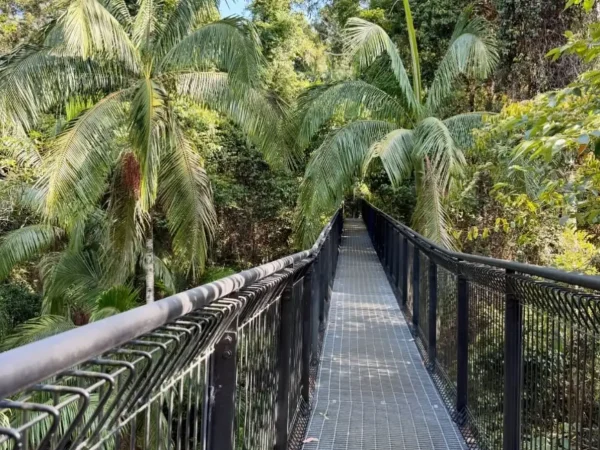
At Springbrook, the Purling Brook Falls circuit drops into the gorge, crosses a suspension bridge and climbs back through forest. Heavy rain can close sections of the track, so check park alerts before leaving.
Best of All Lookout requires only a short walk through high-altitude forest. Elsewhere on the plateau, Canyon Lookout, Goomoolahra Falls and Twin Falls open onto different sections of the escarpment.
On Tamborine Mountain, the 1.1 km return Curtis Falls track slips from tall flooded gums into rainforest. The pool beneath the falls is glow-worm habitat and closed to public access.
Springbrook can feel markedly cooler than the country below. Pack for the mountain rather than the temperature at the start of the drive: sturdy footwear, rain protection and an extra layer earn their place.

Unique Eco Experiences
Distance tells only half the story on these tracks. Steep steps, creek crossings and sustained climbs can turn a few kilometres into a substantial walk, so check the grade before setting out.
Glow Worm Caves Tamborine Mountain takes a different approach to one of the region’s smallest inhabitants. Its purpose-built habitat is not a natural cave; 30-minute guided visits allow glow worms to be observed without entering sensitive wild colonies.
The pace changes again at Thunderbird Park. TreeTop Challenge Tamborine Mountain features eight circuits, more than 120 challenges, and 13 ziplines, with sessions generally lasting two to three hours. Age, reach, and weight restrictions apply.

Boutique Stays And Wineries
Rainforest retreats, eco-lodges, cottages, guesthouses and B&Bs make more sense here than city-style accommodation. Staying in the hills also puts the first walking track of the morning closer to the door.
Tamborine Mountain has the strongest concentration of cellar doors, distilleries and cafés and small producers, with craft drinks and Gold Coast breweries elsewhere through the hinterland. Keep the tasting schedule loose. Mountain kilometres are slow kilometres.
With one day, choose one district: Tamborine Mountain for Curtis Falls and a winery, or Springbrook for Purling Brook Falls and the major lookouts. Two days comfortably cover two mountain areas; three days make room for Lamington and a longer rainforest walk.
A car is essential. National parks, cellar doors and accommodation sit across separate plateaus and valleys, connected by steep, winding roads. Trailhead facilities vary too: check current information from Queensland Parks or the City of Gold Coast rather than assuming drinking water, picnic facilities, or BBQs will be waiting.
FAQ
How many days do you need in the Gold Coast Hinterland?
Allow two days to explore two of the main mountain districts without rushing. Three days is better if you want to include Tamborine Mountain, Springbrook and Lamington, particularly with a longer bushwalk.
Do you need a car for the Gold Coast Hinterland?
Yes. A car is the practical way to explore the Gold Coast Hinterland because national parks, trailheads, waterfalls, wineries and accommodation are dispersed across separate mountain areas. Do not plan the trip around reaching the major natural attractions by public transport.
Which Gold Coast Hinterland national park is best to visit?
Choose Tamborine for shorter rainforest walks and nearby cellar doors, Springbrook for waterfalls and escarpment lookouts, and Lamington for longer rainforest walks. For a first visit focused on scenery rather than long hikes, Springbrook offers the strongest concentration of major natural sights.
What are the best waterfalls in the Gold Coast Hinterland
Purling Brook Falls is the standout at Springbrook, while Curtis Falls is one of the most accessible rainforest waterfalls on Tamborine Mountain. Twin Falls and Goomoolahra Falls add further options around the Springbrook plateau.
Where should you stay in the Gold Coast Hinterland?
Look for rainforest retreats, eco-lodges or cottages, guesthouses or B&Bs close to the mountain district you plan to explore the next morning. Tamborine Mountain offers the broadest choice for wineries and dining, while staying closer to Lamington makes more sense for longer walks.




Experience The Best Of Brisbane
The river is the natural place to start. Ferries and bridges connect the two banks, while riverside walking paths lead between gardens, restaurants and city views.
South Bank Parklands sits directly opposite the Brisbane CBD, bringing together around 15 hectares of parkland, Streets Beach and the Queensland Cultural Centre. Across the river, Queen Street Mall and the 18-hectare City Botanic Gardens offer a mix of busy city streets and quieter waterfront spaces.
Kangaroo Point has some of the best views of the Brisbane skyline and Story Bridge. Nearby, Howard Smith Wharves brings dining and riverside spaces beneath the bridge. New Farm, Fortitude Valley and West End add another mix of parkland, nightlife, leafy streets and charming cafés.

See Brisbane Beyond The City Centre
West of the CBD, Mt Coot-tha Reserve is the place for bushwalking trails, outdoor adventures and panoramic city views, with the 56-hectare Brisbane Botanic Gardens Mt Coot-tha adding another reason to spend time on this side of the city.
Head east and Brisbane meets the bay. Wynnum and Manly have a quieter, more laid-back waterfront feel than the surf coast to the north and south. Further out, Minjerribah (North Stradbroke Island) and Mulgumpin (Moreton Island) bring beaches, walking trails, wildlife and wilder coastal scenery.
Travel inland instead and the Scenic Rim brings mountains, national parks and access to World Heritage-listed rainforests, putting very different landscapes within easy reach of the city.

Food, Art And Culture In Brisbane
South Bank is Brisbane’s main cultural hub. The Queensland Cultural Centre brings the Queensland Art Gallery, Gallery of Modern Art, Queensland Museum, State Library and Queensland Performing Arts Centre together in one convenient riverside cultural precinct. GOMA is also home to the Australian Cinémathèque, where film screenings sit alongside the galleries and exhibitions.
Food and nightlife are more spread out. South Bank works well for riverside dining, while Fortitude Valley mixes restaurants, bars and live music. New Farm has a more relaxed neighbourhood feel built around cafes, and West End is known for independent eateries and a broad mix of international cuisines. Whether the plan is a riverside meal, a night out or a laid-back Brisbane brunch, there are plenty of options.
Brisbane is compact enough to mix art, culture, food and markets into the same day of sightseeing. There is little reason to separate them into dedicated days when the city’s main inner-city precincts fit together so easily.

Make Time For Brisbane
2 to 4 days in Brisbane is a good amount of time for a first visit. Two days gives you enough time to explore the river, South Bank Parklands, the city centre and surrounding neighbourhoods. A third leaves room for Mt Coot-tha or the bayside, while four days makes it easier to add an island trip, the coast or hinterland.
Summer is the hottest and most humid time of year, autumn is milder, winter brings cooler days and evenings, and spring in Brisbane warms up as the jacarandas begin to flower.
You don’t really need a car around central Brisbane. Trains, buses and ferries cover much of the city, while South Bank, the city centre and nearby neighbourhoods are easy to explore on foot. A car becomes more useful for day trips from Brisbane to the coast, hills and surrounding regions.
Accommodation ranges from luxury riverside hotels and central city stays to boutique hotels and apartments in the inner suburbs. That leaves plenty of choice between nightlife, river views and a quieter base.